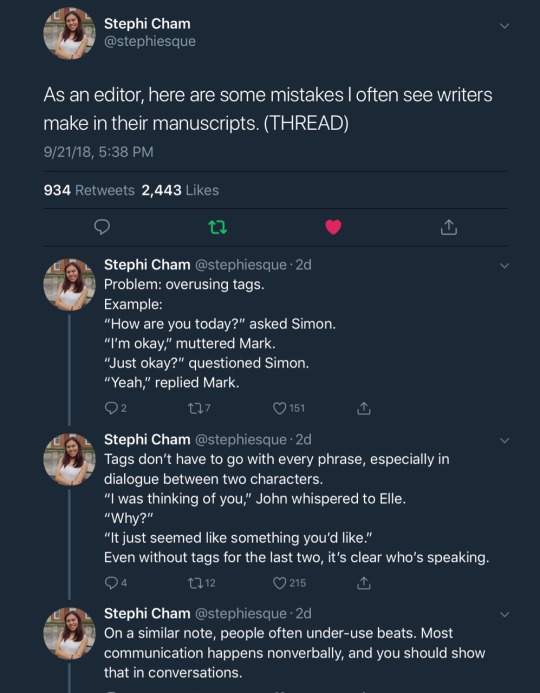
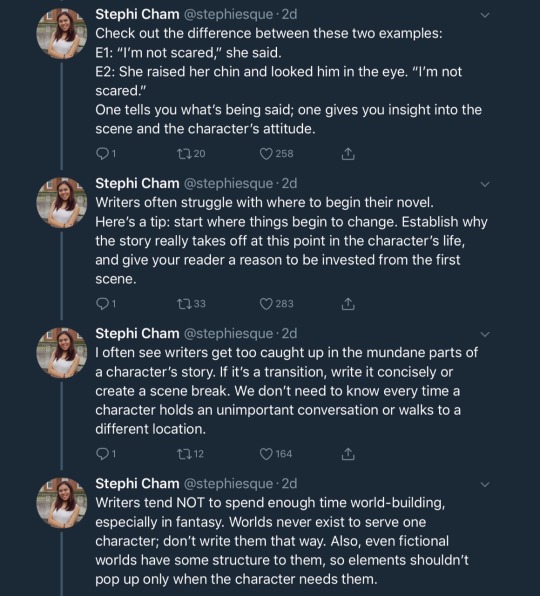
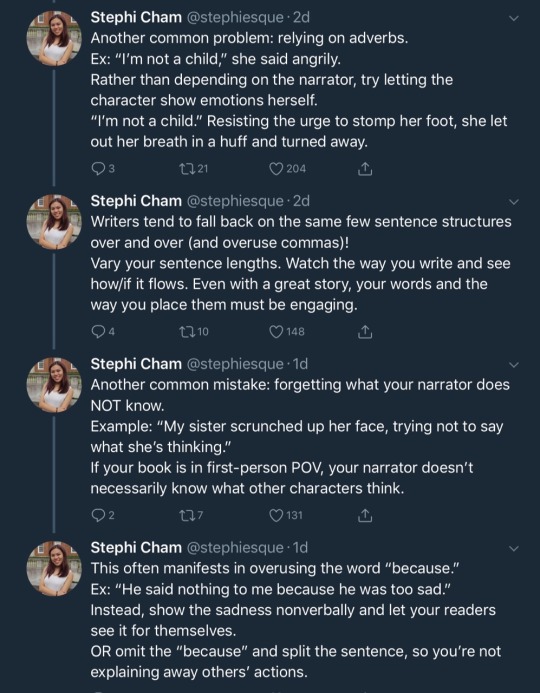
Guys, I edit professionally. This list is legit. Incorporating these suggestions before you hire an editor will save you A LOT of money. Even if you did these and nothing else, you’d see significant overall improvement in your work.
That said, you don’t have to overthink these things when you’re writing a first draft. If you write, “she said angrily” in a first draft, you can always revisit the phrasing in a second draft. I mention this because overthinking style can lead to a loss of momentum, and losing momentum is why so many people never finish a draft. Give yourself permission to write fast, write messy or ugly, and edit your draft into beauty later.
I find it kinda odd how people talk about writing “flawed” characters like the flaws are an afterthought
Like “cool cool we’ve got this perfect hero now to just sprinkle on some Irritability and Trust Issues then microwave for 6 minutes on high until Done”
But I’ve personally found it feels a lot more useful to just… think of the flaws as the Good Traits except bad this time
The protagonist is loyal? Maybe that means they have a hard time recognizing toxic relationships and are easily manipulated by those they want to trust
The hero is compassionate? Maybe they work too hard and overextend themselves trying to help people and then they refuse to ask for help when they need it themselves for fear of burdening others
They’re dedicated to their ideals? Maybe they’re also too stubborn to know when to quit and they have trouble apologizing for their mistakes
If they’re creative, they can also be flighty. If they’re confident, they can be arrogant. If they’re brave, they might be reckless. If they’re smart, they could be condescending. Protective can become controlling, and someone who’s carefree could very well also be emotionally distant
In my opinion, the best “flaws” aren’t just added on afterwards. The best flaws are baked in deep, ‘cause they’re really just virtues turned upside down
It is very important that the language in your novel reflects the time and place in which the story is set.
For example, my story is set in Italy. My characters would never “ride shotgun”, a term coined in US in the early 1900s referring to riding alongside the driver with a shotgun to gun bandits.
Do your research! A free tool that I found to be very useful is Ngram Viewer.
You can type any word and see when it started appearing in books. For example…one of my characters was going to say “gazillion” (I write YA) in 1994. Was “gazillion” used back then?
And the answer is…YES! It started trending in 1988 and was quite popular in 1994.
Enjoy ^_^
This is really important, especially because language can change in very unexpected ways.
For example, did you know that before 1986 people never said “I need to”?Instead, they were far more likely to say “I ought to”, “I have to”, “I must”, or “I should”.
Don’t believe me?
Anyway, most people won’t notice subtle changes like that. But your reader will notice and be confused when characters in your medieval world use metaphors involving railroads and rockets.
One of the things you can do besides use Google Ngrams is to read books or watch movies written in the time period you want to set your story. The key here is that they can’t just be set in that time period, they have to have been made in that time period.
Also, there’s a Lexicon Valley episode on this very topic which I highly recommend. It’s called Capturing the Past.
Also: “okay” and “cool” (in the non-temperature sense) were not in usage until the 20th century. And the phrase “are you alright/all right?” didn’t come into usage until around 1860. Historical fic writers be aware!


 shesaheroyousee